BREAST HEALTH SERIES, PART 2 OF 8
Breast MRI: Who Really Needs One?
By David Z. Schreier, MD, FACS | Breast and General Surgery | West Hills, CA
In Part 1, (the previous blog post) mammograms are discussed as the backbone of breast cancer screening, but that they can miss some cancers, especially in dense breasts. That raises a natural question: why doesn’t everyone just get a breast MRI?
Breast MRI is the most sensitive breast imaging test we have. But “most sensitive” doesn’t always mean “best for you.”
What Is a Breast MRI?
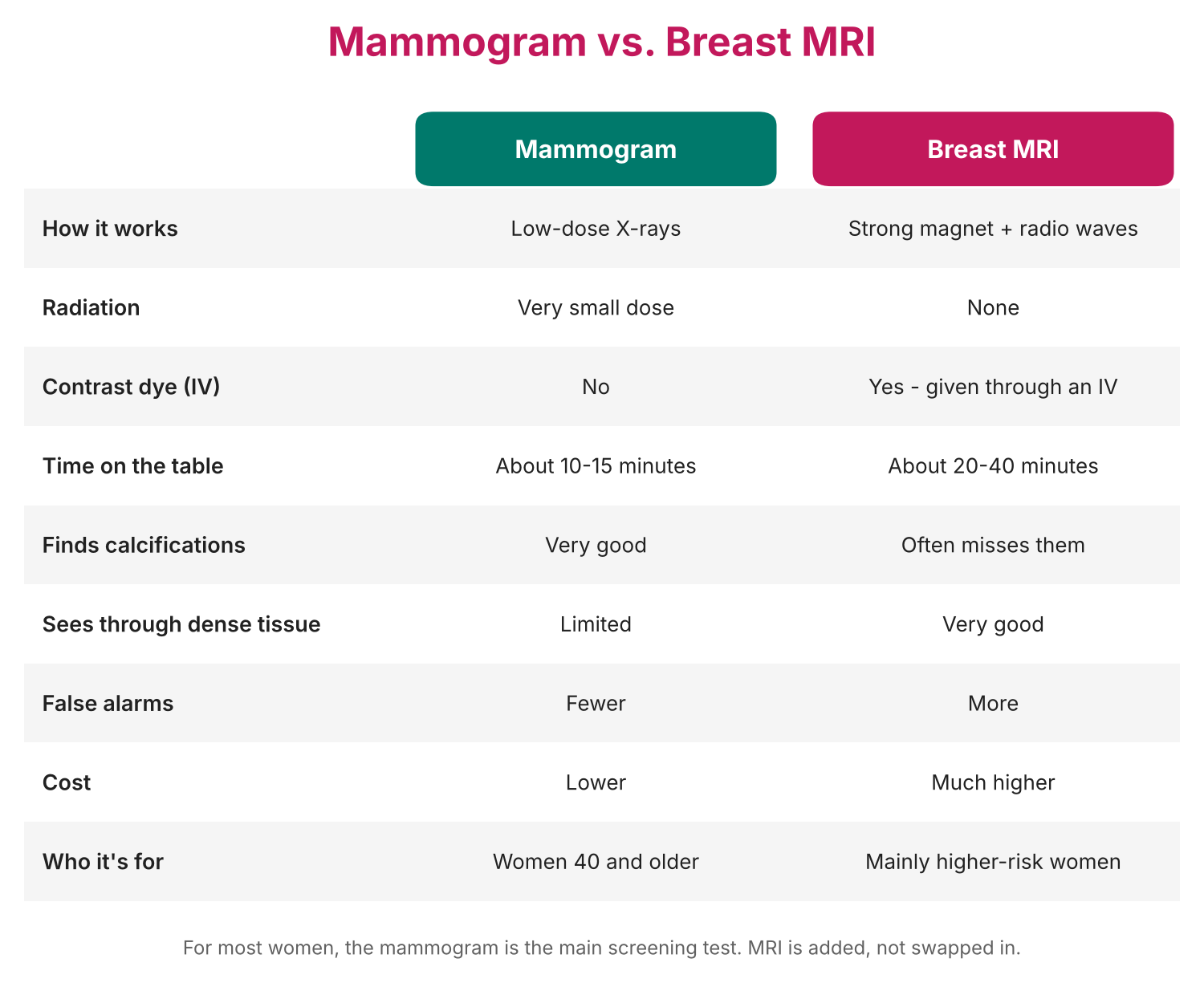
MRI stands for magnetic resonance imaging. Instead of X-rays, it uses a strong magnet and radio waves to make very detailed pictures of the inside of the breast.
Here’s what to expect:
- You lie face down on a padded table, with your breasts resting in openings in the cushion.
- A small IV is placed in your arm so a contrast dye (called gadolinium) can be given partway through the scan.
- The table slides into the MRI tube. The machine is loud, so you’ll get earplugs or headphones.
- The scan takes about 20 to 40 minutes, and you need to stay very still.
Why the dye? Cancers grow their own new blood vessels to feed themselves. The contrast dye flows into areas with extra blood supply and makes them “light up” on the pictures. This is what makes MRI so good at finding cancer.
The Advantages of Breast MRI
- It finds the most cancers. MRI finds more breast cancers than mammogram or ultrasound, but it also has more false-positive findings, which we discuss below. In high-risk women, adding MRI to a mammogram finds many more cancers than a mammogram alone.
- Dense breasts don’t get in the way. On a mammogram, dense breast tissue and cancer both look white, so a cancer can hide in the background. MRI works differently. It shows where the contrast dye collects, so a cancer can stand out clearly even in very dense tissue.
- No radiation. MRI uses no X-rays. That matters for women who start screening at a young age (sometimes as early as 25) and will have many years of scans.
- It helps in special situations. Beyond screening, MRI can help your care team in specific cases, such as checking how a tumor is responding to chemotherapy before surgery, or looking for a hidden cancer when cancer is found in an underarm lymph node.
The Disadvantages of Breast MRI
- More false alarms. Because MRI is so sensitive, it also lights up many things that are not cancer. That leads to more callbacks, more follow-up scans, and more biopsies. For many women, the waiting and worry is the hardest part. MRI-guided biopsies are also longer and more involved than mammogram- or ultrasound-guided biopsies.
- It can miss calcifications. MRI is great at finding masses, but it is not good at showing tiny calcium specks (calcifications). Some early cancers (DCIS) show up only as calcifications. That’s why MRI is used in addition to a mammogram, not instead of one.
- It needs contrast dye. Gadolinium is very safe for most people, but allergic reactions can happen (rarely). People with serious kidney disease may not be able to receive it. Studies have also found that tiny amounts can stay in the body for a long time. The FDA has found no evidence that this is harmful, but it is one reason not to repeat contrast scans without a good reason. MRI with dye is also generally avoided during pregnancy.
- It’s not for everyone’s comfort or body. Lying face down in a narrow, noisy tube for half an hour can be hard, especially if you don’t like tight spaces or have claustrophobia. Some people need sedation to get through an MRI. Some pacemakers, metal implants, and other devices can also make MRI unsafe or impossible.
- Cost and insurance. MRI costs much more than a mammogram. Insurance usually covers screening MRI for women who meet high-risk guidelines, but may not cover it for women at average risk. Always check before you schedule.

Who Should Get a Screening Breast MRI?
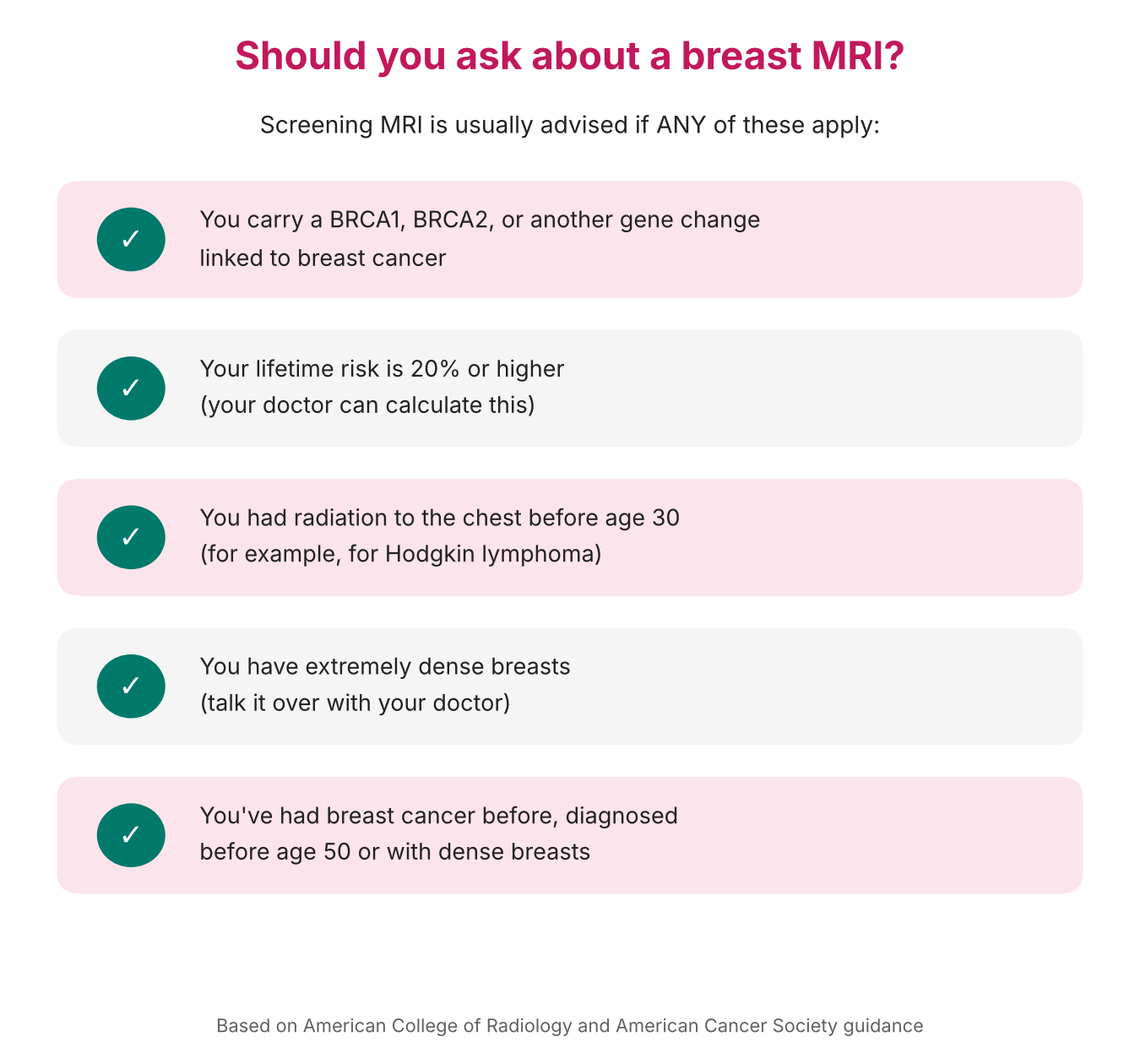
Based on guidance from the American Cancer Society and the American College of Radiology, a yearly screening MRI, in addition to a mammogram, is usually recommended if you:
- Carry a BRCA1 or BRCA2 gene change, or another inherited gene change linked to breast cancer
- Have a parent, sister, brother, or child with a BRCA gene change and have not been tested yourself
- Have a lifetime risk of 20% or higher, based on a risk calculator that looks mainly at family history
- Had radiation to the chest between ages 10 and 30, for example for Hodgkin lymphoma
MRI may also be worth discussing if you have extremely dense breasts, or if you’ve had breast cancer before, especially if it was found before age 50 or you have dense breasts. In these groups, the evidence is still growing and experts don’t all agree, so it’s a decision to make with your doctor.
For women at average risk, screening MRI is generally not recommended. For them, the extra false alarms and biopsies usually outweigh the benefit.
What About MRI After a Breast Cancer Diagnosis?
Many women newly diagnosed with breast cancer wonder if they should have an MRI “just to be safe.” It’s a reasonable question, but the answer isn’t always yes. Large studies have shown that routine MRI after diagnosis increases the number of mastectomies without helping women live longer or lowering the chance of the cancer coming back. That’s because MRI often finds tiny areas of disease that radiation and other treatments would have taken care of anyway, along with spots that turn out not to be cancer at all. The American Society of Breast Surgeons does not recommend MRI for every newly diagnosed patient. Instead, your surgeon will order one when there is a specific reason it will change your treatment plan.
What the Research Shows
- COMICE trial (United Kingdom, 2010): About 1,600 women with breast cancer were randomly assigned to have an MRI before surgery or not. MRI did not lower the number of women who needed a second operation.
- MONET trial (Netherlands, 2011): Adding MRI before surgery did not reduce second operations. In fact, the MRI group needed more of them.
- Combined studies: When researchers pooled the results of many studies, MRI before surgery led to more mastectomies, without fewer second operations or a lower chance of the cancer coming back.
Another Option: Contrast-Enhanced Mammography
Contrast-enhanced mammography is a mammogram done after contrast dye is given through an IV. Like MRI, it highlights areas with extra blood supply. It is a newer, emerging test that is becoming more widely available, and it can be an option for some women who can’t have an MRI.
Questions to Ask Your Doctor
- What is my lifetime risk of breast cancer?
- How dense are my breasts?
- Should I have genetic testing based on my family history?
- Would adding MRI (or ultrasound) to my mammogram help me?
- Will my insurance cover it?
Key Takeaways
- Breast MRI is the most sensitive breast imaging test, and it isn’t blocked by dense tissue.
- It also causes more false alarms, needs IV dye, costs more, and can miss calcifications.
- MRI is added to a mammogram, not used instead of one.
- It’s most helpful for women at high risk: gene carriers, a lifetime risk of 20% or more, or past chest radiation.
- For most newly diagnosed patients, MRI before surgery doesn’t improve results and can lead to additional diagnostic studies, biopsies, and more mastectomies, even when a lumpectomy with radiation would be an appropriate treatment.
- If you’re not sure where you stand, ask for a risk assessment.
Coming Up Next
In Part 3, we’ll tackle a question I hear all the time: “My family wants me to have a mastectomy. Isn’t a lumpectomy good enough?” The answer may surprise you: bigger surgery isn’t always better surgery. Have questions about your risk, your breast density, or whether MRI is right for you? Dr. Schreier’s office in West Hills can help. Contact us to schedule a visit.
Sources
- Turnbull L, et al. Comparative effectiveness of MRI in breast cancer (COMICE) trial: a randomised controlled trial. Lancet. 2010;375:563-571. https://doi.org/10.1016/S0140-6736(09)62070-5
- Peters NH, et al. Preoperative MRI and surgical management in patients with nonpalpable breast cancer: the MONET randomised controlled trial. Eur J Cancer. 2011;47:879-886. https://doi.org/10.1016/j.ejca.2010.11.035
- Houssami N, Turner RM, Morrow M. Meta-analysis of pre-operative MRI and surgical treatment for breast cancer. Breast Cancer Res Treat. 2017;165:273-283. https://doi.org/10.1007/s10549-017-4324-3
- Houssami N, et al. Preoperative MRI and breast cancer recurrence: individual patient data meta-analysis. J Clin Oncol. 2014 (summary). https://ascopost.com/News/11907
- American Cancer Society. Breast MRI Scans. https://www.cancer.org/cancer/types/breast-cancer/screening-tests-and-early-detection/breast-mri-scans.html
- American Society of Breast Surgeons. Consensus Guideline on Diagnostic and Screening Magnetic Resonance Imaging of the Breast. https://www.breastsurgeons.org/docs/statements/asbrs-mri.pdf
- Monticciolo DL, et al. Breast Cancer Screening for Women at Higher-Than-Average Risk: Updated Recommendations From the ACR. J Am Coll Radiol. 2023. https://www.jacr.org/article/S1546-1440(23)00334-4/fulltext
- S. Preventive Services Task Force. Breast Cancer: Screening, Final Recommendation (2024). https://www.uspreventiveservicestaskforce.org/uspstf/recommendation/breast-cancer-screening
- S. Food and Drug Administration. Gadolinium-Based Contrast Agents (GBCAs) Safety Communication. https://www.fda.gov/drugs/drug-safety-and-availability/fda-drug-safety-communication-fda-warns-gadolinium-based-contrast-agents-gbcas-are-retained-body
This article is for general education and is not a substitute for medical advice. Please talk with your own doctor about your personal screening needs.